
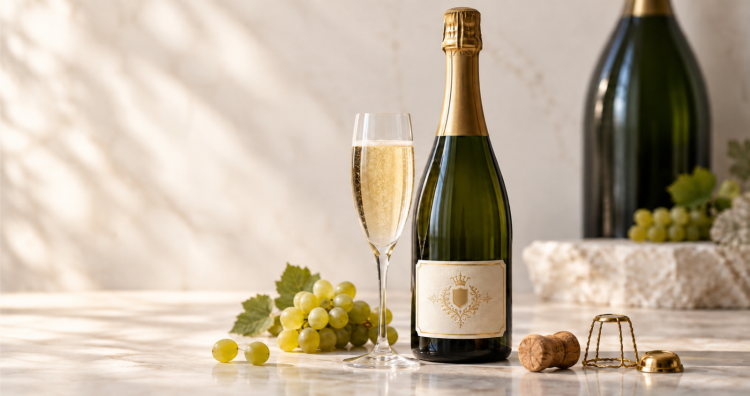
While many people raise a glass at celebratory gatherings, few know how champagne gets its fizz, why white champagne is made from black grapes, or what the small letters on the label actually mean.This wine, cultivated in the Champagne region of France, is rich in fascinating history—from its origin and grape varieties to its production methods, labels, and even the bottles themselves. In this article, we’ll present some trivia about Champagne in a Q&A format—knowledge that will make your next glass a little more interesting.
Sponsored by
Q1. What is the definition of ‘Champagne’ in the first place?A: A sparkling wine produced in the Champagne region of France in accordance with AOC regulations.
“Champagne” is the name of a region in northeastern France. Only sparkling wines produced in the designated Champagne region using authorized grape varieties harvested within that region—and made in accordance with AOC regulations regarding yield, pressing, secondary fermentation in the bottle, and aging—are permitted to bear the name “Champagne.” Even if the same method of secondary fermentation in the bottle is used outside the Champagne region, the wine cannot, in principle, be called “Champagne.” Incidentally, products labeled “California Champagne” still exist in the United States today.This is because certain labels that received approval from the U.S. government prior to March 10, 2006, are permitted to continue using the term “Champagne” under a grandfather clause in the EU-U.S. Wine Trade Agreement.
Q2. What is the Champagne region like?A: A cool wine-growing region in northeastern France, stretching about 150 km east of Paris.
The Champagne region is a wine-growing area located in northeastern France.About 150 km east of Paris, vineyards stretch out around cities such as Reims and Épernay.It is the northernmost of France’s major wine-producing regions and is characterized by a cool climate that helps preserve the acidity of the grapes. The region’s iconic chalky and limestone soils provide excellent drainage, supporting the cultivation of grapes used to make Champagne.The main growing regions are the Montagne de Reims, Vallée de la Marne, Côte des Blancs, Côte de Sézanne, and Côte des Bar—five distinct areas in total.Each area differs in climate, soil, and slope orientation, and there are variations in the grape varieties each region specializes in—for example, Pinot Noir is widely cultivated in the Montagne de Reims, Meunier in the Vallée de la Marne, and Chardonnay in the Côte des Blancs.
Q3. How many types of grapes are used in Champagne?A: There are eight officially approved grape varieties. However, three varieties account for approximately 99.7% of the total.
There are eight officially approved grape varieties used in Champagne.However, three varieties—Pinot Noir, Chardonnay, and Meunier—account for approximately 99.7% of the cultivated area in the Champagne region. The remaining five varieties are Albane, Petit Meslier, Pinot Blanc, Pinot Gris, and Chardonnay Rosé, which was officially approved in 2025. Although the quantities grown are very small, this group includes varieties that have been cultivated in Champagne since ancient times.Furthermore, separate from these eight varieties, “Voltis” is currently approved on a trial basis with the aim of improving disease resistance and adapting to climate change.
Q4. How can white Champagne be made from black grapes?A: Because the juice itself is white, even in black grapes.
Of the three representative Champagne grape varieties, Chardonnay is the only white grape.Pinot Noir and Meunier are black grapes with dark skins . Yet many champagnes turn out white because, even with black grapes, the juice itself has almost no color. If the skins are separated from the juice immediately after pressing the black grapes—before the skin color transfers to the juice—it is possible to produce white wine. White Champagne made exclusively from black grapes is called “Blanc de Noirs.” The name means “white made from black.”Made from Pinot Noir and Meunier, it generally has a rich body and tends to be full-flavored. Meanwhile, champagne made exclusively from white grapes is called “Blanc de Blancs.” This term means “white made from white,” and most products currently on the market are made with Chardonnay.
Q5. How is the carbonation in Champagne produced?A: Sugar and yeast are added to the base wine, and fermentation occurs in the bottle to produce carbonation.
To make Champagne, a still base wine is first produced. After blending these wines, “Liqueur de Tirage” is added. This liquid, containing sugar and yeast, is used to trigger a second fermentation inside the bottle. When the yeast breaks down the sugar, it produces alcohol and carbon dioxide; as the carbon dioxide dissolves into the wine within the sealed bottle, this creates the carbonation in champagne.Champagne production is legally required to undergo this “secondary fermentation in the bottle.” Additionally, since the pressure inside a bottle after fermentation is complete is about three times that of a standard car tire, Champagne bottles are made to be sturdier than those used for regular wine.
Q6. How long is Champagne aged before it’s ready?A: At least 15 months for non-vintage; at least 3 years for vintage.
Once the base wines are blended, sugar and yeast are added, and the wine is bottled, the secondary fermentation in the bottle described above begins.After fermentation, the champagne continues to age in the bottle. There are regulations governing this aging period for champagne: Non-Vintage (NV) champagne—which is typically made by blending wines from multiple harvest years—must age for at least 15 months after bottling. For Vintage Champagne, which uses grapes harvested in a specific year and displays that year on the label, the minimum aging period is set at 3 years. In practice, many producers exceed these regulations, aging NV Champagne for 2 to 3 years and Vintage Champagne for 4 to 10 years. During aging, yeast that has completed secondary fermentation remains in the bottle as sediment. This is known as “lees.”Allowing the wine to remain in contact with this lees for an extended period creates complex aromas reminiscent of bread, baked goods, and toast.
Q7. What process does champagne undergo after aging to reach its final form?A: The lees are gathered at the neck of the bottle and removed, and the wine is finally finished by adjusting its sweetness and acidity.
Once champagne has finished aging, the lees remaining in the bottle are first gathered toward the neck. This process is called “Remuage.” In the traditional method, the bottles are placed at an angle on a slotted rack called a “pupitre” and gradually rotated while slowly tilting the neck downward. By repeating this process, the sediment that had spread throughout the bottle is gathered near the neck.In the past, skilled craftsmen performed this process by hand, one bottle at a time; however, today the mainstream method involves using a machine called a “Gyropalette” to rotate and tilt large numbers of bottles simultaneously.
After the lees have been gathered through remuage, the process of actually removing them is called “Dégorgement.” The neck of the bottle is chilled to approximately -27°C to freeze the lees along with the wine, and the pressure inside the bottle when the cork is removed forces them out.
Next comes “Dosage.” To compensate for the loss caused by dégorgement, “Liqueur d’Expédition” (a mixture of wine and sugar) is added to adjust the final level of sweetness. The finished champagne is classified as Brut, Extra Brut, Demi-Sec, etc., depending on its sugar content, and there is also a type called Brut Nature, which contains no added sugar.
Q8. Is there a ‘classification’ system for Champagne?A: In the past, there was a system of classification based on the ‘villages’ where the grapes were grown.
In the past, the Champagne region had a system called the “Échelle des Crus” (Scale of Crus), which assigned ratings to each village where grapes were grown. Launched in 1911, this system rated each village on a scale of 80% to 100%, and these figures were reflected in the trading price of the grapes. For example, grapes from a village rated at 95% would be traded at 95% of the standard price.Later, the designations “Grand Cru” were introduced for villages rated at 100%, and “Premier Cru” for those rated at 90% or higher. Although the Échelle des Crus, which was used to determine grape prices, was abolished in 2010, these designations remain in use today, and Champagne made exclusively from grapes grown in these villages may be labeled as “Grand Cru” or “Premier Cru.” In other words, the terms “Grand Cru” and “Premier Cru” in Champagne do not represent a ranking of producers or the bottles themselves, but rather derive from the historical classification of the villages where the grapes are grown.
Q9. What can you tell by looking at a Champagne label?A: You can determine the sweetness level, vintage, grape varieties used, and even the producer’s business structure.
Champagne labels contain a variety of information that helps you learn about a specific bottle.You can always find the “Champagne” designation indicating the AOC, as well as the brand name, producer’s name, volume, alcohol content, and sweetness level. Furthermore, depending on the product, the vintage, the type of grapes used, and the aforementioned village classifications may also be listed. Among these, the most important details to remember are the notation indicating the sweetness level and the producer’s registration number. Sweetness levels are classified into several categories based on sugar content, and the first two letters of the producer registration number reveal the production method used to make that champagne. Their meanings are as follows.
Sweetness Level
| Notation | Sugar Content |
|---|---|
| Brut Nature / Pas Dosé / Dosage Zéro | Less than 3 g/L, with no added sugar |
| Extra Brut | Less than 6 g/L |
| Brut | Less than 12 g/L |
| Extra Dry | 12–17 g/L |
| Sec | 17–32 g/L |
| Demi-Sec | 32–50 g/L |
| Doux | Over 50 g/L |
Producer Registration Number
| Labeling | Name | Meaning |
|---|---|---|
| NM | Négociant Manipulant | A producer who makes champagne using grapes grown on their own vineyards as well as purchased grapes |
| RM | Récoltant Manipulant | A producer who makes and sells Champagne using grapes they have grown themselves |
| CM | Coopérative de Manipulation | A cooperative that produces Champagne using grapes grown by its members |
| RC | Récoltant Coopérateur | A producer who delivers grapes grown on their own vineyard to a cooperative and sells the champagne produced there under their own brand |
| SR | Société de Récoltants | A structure in which multiple growers—such as members of the same family—collaborate to produce Champagne from their own grapes |
| ND | Négociant Distributeur | A business that purchases finished Champagne, labels it under its own brand, and sells it |
| MA | Marque d’Acheteur | Champagne sold under the brand name of the buyer, such as a retailer |
Q10. Are giant champagne bottles custom-made? Or do they have specific names?A: There are specific names. Bottles up to 30L have unique names based on their capacity.
There are several large champagne bottles exceeding 750 ml, and each capacity—from 1.5 L up to a maximum of 30 L—has its own specific name. As the bottles get larger, the names of figures from the Old Testament and other sources become more common.This naming convention is said to have been started by champagne houses in the 19th century and later spread to other wine-producing regions. However, it remains unclear why biblical figures were chosen. For example, “Jéroboam” refers to a king of ancient Israel,“Mathusalem” is a figure from the Old Testament said to have lived to the age of 969, and “Nabuchodonosor” is derived from Nebuchadnezzar II, the ancient Babylonian king.
See Champagne Bottle Sizes and Names
| Capacity | Name | Equivalent to a 750ml bottle |
|---|---|---|
| 750 ml | Bouteille | 1 bottle |
| 1.5 L | Magnum | 2 bottles |
| 3 L | Jéroboam | 4 bottles |
| 4.5 L | Réhoboam | 6 bottles |
| 6 L | Mathusalem | 8 bottles |
| 9 L | Salmanazar | 12 bottles |
| 12 L | Balthazar | 16 bottles |
| 15 L | Nabuchodonosor | 20 bottles |
| 18 L | Salomon | 24 bottles |
| 27 L | Primat / Goliath | 36 |
| 30 L | Melchizedec / Midas | 40 bottles |








![Jackie Chan: The Man Who Turned His Back on the Path to Becoming Bruce Lee’s Successor and Changed the World with Comedy and Action [Men’s Biographies]](https://otokomaeken.com/wp-content/uploads/2026/10/7966bae78213db11914ad7af893f8431-750x396.png)

![Steve McQueen: A Man Who Lived Freely and Never Compromised on Duty or Principle [Men's Biographies]](https://otokomaeken.com/wp-content/uploads/2026/09/7966bae78213db11914ad7af893f8431-4-750x396.png)



![What are the specific 5 changes that muscle training can bring to a man? ["The truth as experienced by practitioners."]](https://otokomaeken.com/wp-content/uploads/2023/12/3ecb709c1f1613850249ba743b4b1457-750x396.jpg)

![Paul Newman: The Man Who Turned Fame into Money and Donated All His Profits to Charity [Men's Biographies]](https://otokomaeken.com/wp-content/uploads/2026/08/2071d8b3d6b46d67221ad9d050c85da8-750x396.png)