![Why do Japanese men find "women with small faces" so beautiful? From Edo Period Beauty Paintings to Smartphone Apps. A Cultural History of the Belief in Small Faces ].](https://otokomaeken.com/wp-content/uploads/2025/10/4035699b92f18f129ae97e544df3c384-750x396.jpg)
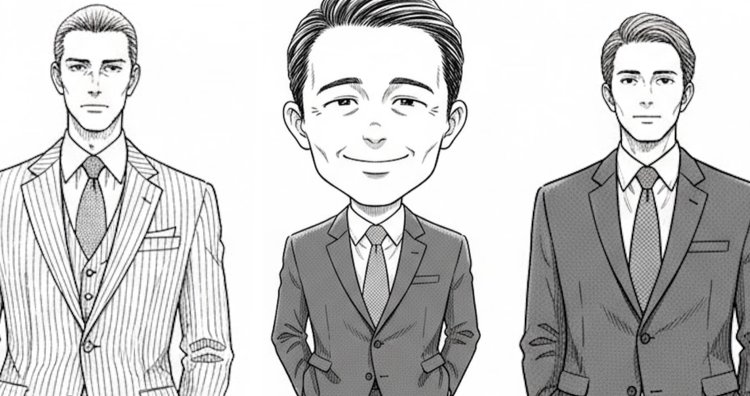
Why are men attracted to women with small faces? Is it biological instinct? Is it a cultural fad?” Or is it commercial imprinting?” In this article, we will examine the reasons why.
Sponsored by
What Evolutionary Psychology Tells Us About Why We Are Attracted to Women with Small FacesWhy do we think women with small faces are beautiful?
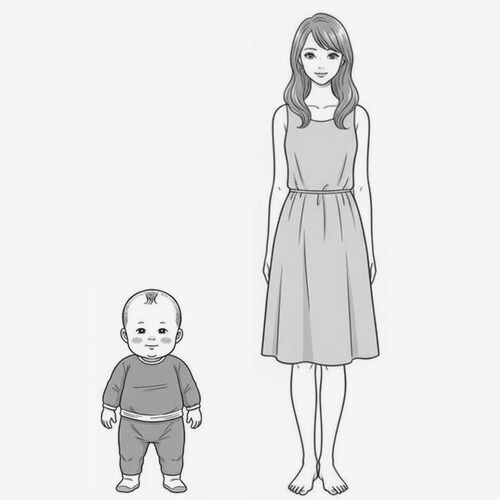
Why do we think women with small faces are beautiful? According to Nancy Etcoff’s ‘Why Beauty Makes Us Happy,’ people instantly read facial proportions as a “sign of fertility. “A man’s choice of sex is based on his visual perception. Men are the “sex of choice by sight” and respond instinctively to well-proportioned proportions. However, this innate tendency has been amplified and staged by the media and culture of each era, as well as the forces of the capitalist market. From Edo period beauty paintings to smartphone apps, we can trace 150 years of fluctuating ideals of “head-body balance” to discover the essence behind our aesthetic sensibilities.
References:
Nancy Etcoff, ‘Survival of the Prettiest’, Hayakawa Bunko, 2000.
David M. Buss, ‘Evolutionary Psychology: The Origins of Human Behavior and Mind’, Shinyosha, 1999.
In the Edo period, beauty was considered beautiful if it could be seen from a distance on a stage. Ukiyo-e paintings of beautiful women also depicted the ideal of “stage-ready” forms. In order to convey emotion even to an audience seated far away, the outlines were enlarged and facial expressions were exaggerated. (According to Tatsuo Tsuji’s ”Genealogy of Fantasy,” the beauty of ukiyoe was based on the “clarity of vision from a distance.) The situation changed drastically with the advent of photography and film after the Meiji period. Audiences began to see faces from a “closer” vantage point on the screen and to read the details of facial expressions. Actors with large faces, who were dominant on the stage, now appear “stretched out” in the image. As the distance of the media changed, the proportions of beauty also reversed. As Marshall McLuhan noted in his ‘ Theory of Media,’ “the media are an extension of the senses. The extension of vision has transformed the aesthetic sense itself.
![Art and painting by Kitagawa Utamaro and Tsutaya Shigesaburo for Woman Blowing Poppins [197604431],](https://otokomaeken.com/wp-content/uploads/2025/10/aflo_197604431-scaled.jpg)
Courtesy of JAPACK/Afro.
References:
Tadashi Tsuji, ”A Genealogy of Strange Ideas,” Perikansha, 1970
Marshall McLuhan Understanding Media: The Extensions of Man McGraw-Hill, 1964
Why Japanese Men Have Come to Seek 'Well-Dressed Beauty'After the Meiji Restoration, Western Art Brought the Spell of 'Eight Headedness'
The Meiji Restoration introduced Western art education to Japan. Inscribed therein were numerical ideals such as the “golden ratio” and the “eight-headed body. It was taught that the human body is “well-rounded” when the head is 1/8th of the entire body, and that the more the body meets this ratio, the more “beautiful” it is (“Vitruvian theory of proportion”). Eventually, this “beauty as a numerical value” permeated society through education and the media, and the formula “a small head = a well-proportioned body” became common knowledge. The “ambiguous beauty” that was once perceived by the senses was transformed into a ratio like a drawing, and there was a shift toward a “numerically designable beauty. Okakura Tenshin, in his “Historiography of Japanese Art,” declared, “‘Art is a system. A certain head-balance is an aspect of Western art’s institutional beauty.
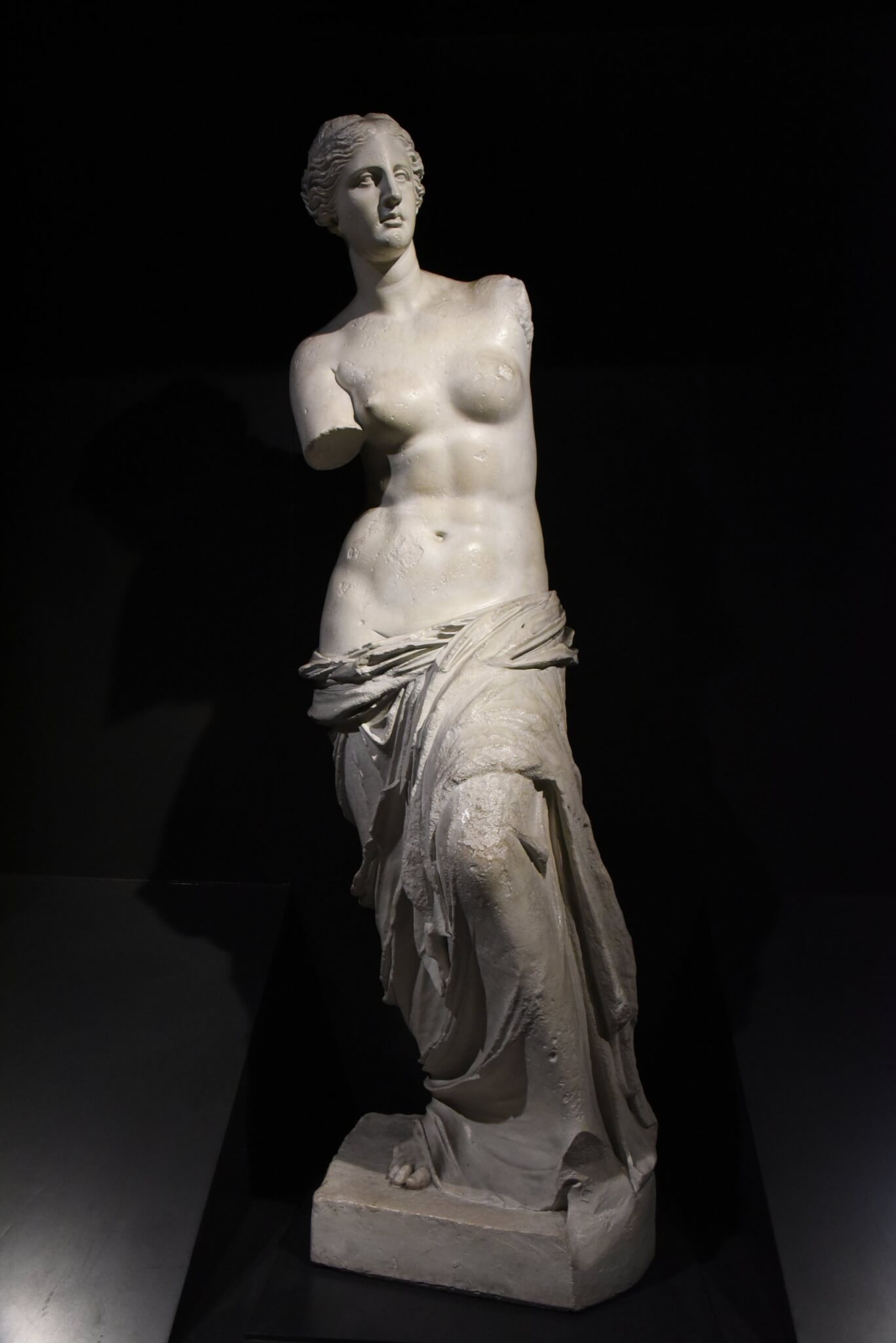
Photo: Abaca/Afro A replica of the Venus de Milo, the famous armless Greek goddess statue, was endowed with two prosthetic limbs made by 3D printers for a campaign by Handicap International carried out in Paris, France, on Tuesday March 6, 2018, as part of the organisations #bodycantwait campaign. photo by Alain Apaydin/ABACAPRESS.COM
References:
Okakura Tenshin, ”Nihon Bijutsu Shisetsu Tsuna”, Iwanami Shoten, 1904
Leonardo da Vinci Vitruvian Man c.1490.
In 1953, Kinuko Ito won third place at the Miss Universe World pageant. The term “eight-headed beauty” became a buzzword, and the beauty of Japanese women came to be measured by “international standards. The small face was a symbol of this. Western facial features and frames were reported as “world-class beauty,” and imitating them was considered a sign of “modernity. In other words, the small face was not a sign of refinement, but of assimilation. As the cultural anthropologist Edward Said has pointed out, in Western-based societies, the East has always been positioned as the “chaser” (Edward W. Said, Orientalism). Postwar Japanese advertisements, films, and magazines imported the “Western body” as an ideal and translated it for the domestic market. Japanese features such as round faces and short legs were hidden from the public, and sharp contours and long legs were considered the “world-class ideal. The belief in small faces was born as an extension of this ” translated beauty.
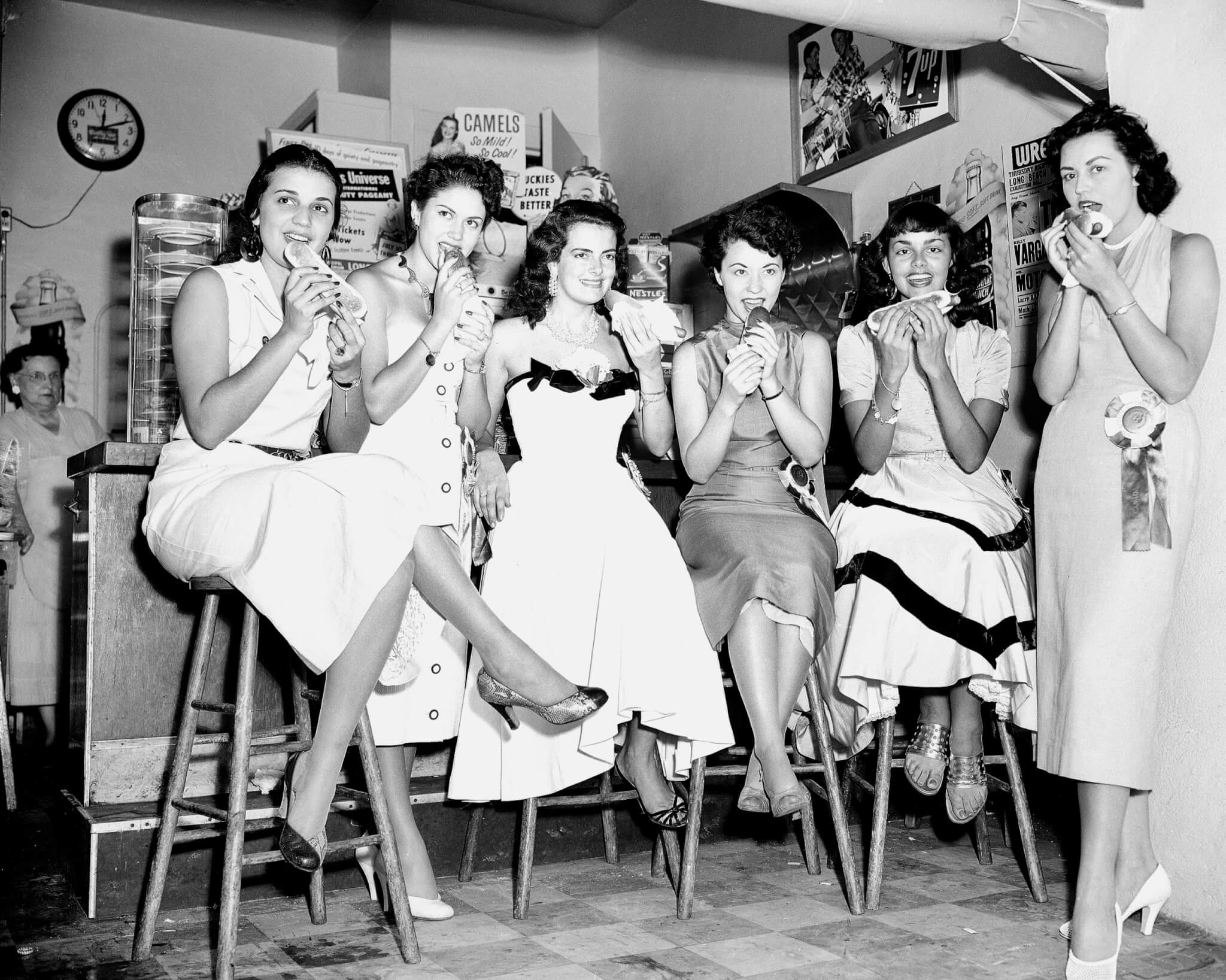
Photo: AP/AfroSix candidates for the Miss Universe title grab a quick United States-style lunch between rehearsals for the contest at Long Beach, Calif. For some it was their first taste of the famed hot dog. Left to right: Miss Puerto Rico, Wanda Irizarry; Miss Mexico, Ana Bertha Lepe; Miss Uruguay, Alicia Ibanez; Miss Arizona, Eleanor Ruth Gross; Miss Panama, Emita Arosemena; and Miss Canada, Thelma Brewis.
References:
Edward W. Said Orientalism Pantheon Books, 1978
David M. Buss Evolutionary Psychology: The New Science of the Mind Allyn & Bacon, 1999
The small face boom in Japan in the 1990s
In the 1990s, the appearance of Namie Amuro turned “small face = cute” into a national value. Magazines recommended voluminous hairstyles and high-waisted bottoms to create the illusion of a smaller head, and beauty appliances released “small face rollers” one after another. A small face was no longer something to aspire to, but a beauty that could be purchased. The sociologist Pierre Bourdieu wrote in “Distinction” that “‘taste’ is a sign of class. In other words, the taste for a “small face” also functioned as a signifier of social class. The image of cleanliness, urbanity, and sophistication. The small face became a symbol of the desire for social advancement.

However, it is not only the market principle that has made the “small face” such a “selling face. The smaller the facial space, the more the emotional entrances and exits, such as the eyes and mouth, are emphasized, making facial expressions easier to read. The small face was also designed to enhance emotional legibility. A face that makes the viewer feel ” understandable. This stimulates men’s aesthetic psychology. Men are attracted to beauty that they can understand. Women whose emotions are easy to read and whose reactions are easy to imagine provide both a sense of security and a sense of control. In other words, the “small face” boom of the 1990s was not simply a matter of proportion, but a phenomenon of society’s reproduction of the image of women as “others with whom we can empathize. The small face stood at the interface between men’s instinctive desire to “like a woman who understands” and the “sellable beauty” designed by capitalism.
References:
Pierre Bourdieu Distinction: A Social Critique of the Judgement of Taste Harvard University Press, 1984
Jean Baudrillard La société de consommation Gallimard, 1970
Cunningham, M.R., et al. “Their ideas of beauty are, on the whole, the same as ours.” Journal of Personality and Social Psychology, 1995
Entering the 21st century, apps automatically correct for beauty
small-face Beliefs, far from having come to an end in the 21st century, have been amplified by technology. Smartphone cameras and social networking video culture are designed to make people’s heads look better. Apps’ lens corrections and filters automatically adjust to balance the overall image, even when the composition is centered on the face. In addition, the photographer himself consciously chooses framing that makes the legs look longer, such as vertical compositions and low angles. The accumulation of such calculations and habits has resulted in the “ideal head height” of today.

Men are attracted to “women with small faces” as a result of the fact that the “object of their admiration,” such as idols and models, have been made smaller through photographic techniques, plastic surgery, and styling, and have been projected as ideal images. It is no exaggeration to say that social networking sites are now playing the role of defining the ideal itself. It is no exaggeration to say that social networking sites are now playing the role of defining the ideal itself.

References:
Yeonjoo Kim, ”The Society of Plastic Surgery,” Seidosha, 2016
Shoshana Zuboff The Age of Surveillance Capitalism PublicAffairs, 2019
As described above, the sense of feeling that a small face is beautiful is both natural and an illusion created by the times. A man who is able to look people straight in the eye even after knowing these tricks is attractive. We want to have eyes that can see through the air they breathe, their way of life, and the contours of their heart, rather than the size of their face. The ability to sense the strength and kindness within. This is the aesthetic sense of a “good man. I want to be a man who knows why he is attracted to someone and can love them beyond that.














![Steve McQueen: A Man Who Lived Freely and Never Compromised on Duty or Principle [Men's Biographies]](https://otokomaeken.com/wp-content/uploads/2026/09/7966bae78213db11914ad7af893f8431-4-750x396.png)

![Paul Newman: The Man Who Turned Fame into Money and Donated All His Profits to Charity [Men's Biographies]](https://otokomaeken.com/wp-content/uploads/2026/08/2071d8b3d6b46d67221ad9d050c85da8-750x396.png)
![George Foreman: From World Champion to Pastor—The Boxer Who, After a 10-Year Hiatus, Knocked Out an Undefeated Champion at Age 45 [Men's Biographies]](https://otokomaeken.com/wp-content/uploads/2026/09/7966bae78213db11914ad7af893f8431-2-750x396.png)