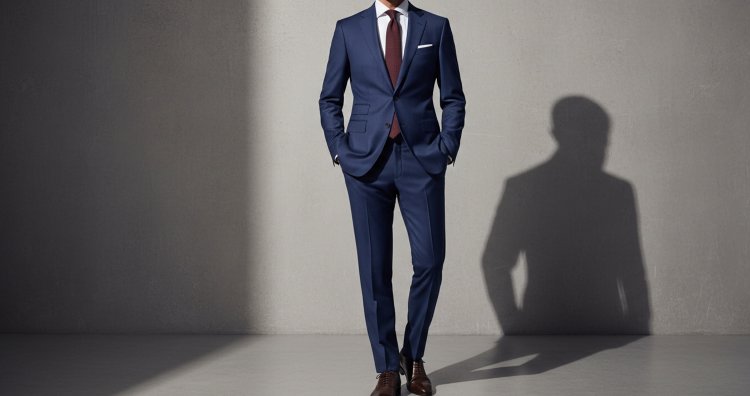
The act of wearing a suit is a ” silent eloquence ” that spells out one’s aesthetics and culture. The “why” of dressing is organized in 20 Q&As. Knowing the logic of the global standard will secure your credibility more eloquently than any self-introduction.
Sponsored by
Q1. Why is a black suit and white tie still the 'correct' choice for a Japanese wedding?A. The white tie is 'a substitute symbol created by a lack of supplies. Festivities should be celebrated with festive colors.
The white tie at wedding receptions is a product of the “ultimate simplification” in the postwar shortage of supplies. The wisdom of using a single black suit with only a necktie, ” black for mourning and white for celebration,” became fixed as a manner of dress. However, at international festivals, the guests are also a colorful element of the venue. The world standard way of expressing happiness is to visualize “joy” with a silver-gray, champagne gold, or pastel-colored tie.
Q2. Are button-down shirts not versatile? Why should they be avoided at important business meetings?A. Button-downs have a 'sporting' DNA. It is wise to avoid them at important business meetings.
The button-down has its origins in the polo game of the late 19th century. It was first used to secure a jockey’s collar to prevent it from flipping, and it has a “sporting” pedigree from birth. Hence, the casual roll created by the buttons on the collar is incompatible with the authoritative tension that important business meetings demand. The true value of this shirt should be demonstrated only in the context of an ” intelligent holiday ” with chinos and a blazer, etc.
Q3. How should the problem of innerwear showing through under a dress shirt be solved?A. Shirts are essentially ' underwear. It is modern etiquette not to expose its inner 'borderline.'
In Western clothing, a dress shirt is itself defined as ” underwear. Therefore, to add a layer of innerwear under the shirt and make its contour and color transparent is to expose a private boundary that should not be there, namely, “the layer beneath the underwear. In Japan’s hot and humid environment, it is reasonable to wear innerwear, but we should choose a beige V-neck that blends in with the skin and make its presence thoroughly invisible. This is the only way to ensure a sense of cleanliness and dignity.
Q4: What is the problem with the Japanese summer scene of short-sleeved shirts and ties?A. There is no logic in wearing a tie with short sleeves that have no cuffs. The correct answer is 'no tie for short sleeves' and 'long sleeves with arms rolled up' for a tie.
The act of wearing a necktie is essentially the most formal indication of one’s intention to wear a jacket. However, short-sleeved shirts do not have ” cuffs ” that should peek out from the cuffs of a jacket. It is a structural contradiction to add formal weight only to the neck of a shirt that lacks the parts that control the finish of the outfit. If one wants to resist the heat, he or she should either keep it casual by wearing a short-sleeved, no-tie style, or, if a tie is necessary, ” roll up the long sleeves beautifully ” to keep cool while ensuring the presence of the cuffs. This distinction is the boundary of intelligent dress code in the Japanese summer.Q5. Is it necessary to have a ' dimple' under the knot of a tie? Are there occasions when it is better not to make one?A. Dimples are decorations that add glamour. In mourning, it is good manners to intentionally 'tie it flat.'
Dimples (indentations in knots) are a decorative technique that adds depth to the V-zone and makes an outfit look more festive. However, the rule of thumb for funerals (mourning events) is to avoid dimples and to keep the dress flat. It is a sign of modesty toward the deceased to suppress the aggressive intention to adorn the outfit, and it is in this switch that the discretion of an adult is shown.Q6. What is the ''correct length'' of a necktie?A. Ties are 'vertical bridges' that connect the upper and lower parts of the body. A fine adjustment to the depth of the crotch completes the discipline of the attire.
The correct length of a tie corresponds to the depth of the slacks’ crotch: ideally, the tip should touch the center of the buckle as a vertical bridge that connects the V-zone to the waistline without interruption. A deep crotch pant will inevitably be tied short, but this is only a logical consequence of protecting the structural boundary. This commitment to discipline completes the architectural harmony of the outfit.Q7. Suit jacket, is the bottom button unbuttoned?A. It was designed from the design stage with the assumption that it would be ' removed. The bottom button is a margin as decoration.
The most popular theory about the origin of the unbuttoned manner is that King Edward VII of England unbuttoned it because of his changing body shape, and it spread to his court as a sign of respect. With this history as a backdrop, modern jackets are cut to be completed with the bottom part unbuttoned. Forcing a jacket to be fastened at this point would ruin the beautifully designed hemline and cause unnatural wrinkles around the waist. If there are three buttons, there is one in the middle, and if there are two buttons, there is one at the top. Respecting this functional margin shaped by history is a sign of a proper understanding of the structure of clothing.Q8. What should I do with the buttons of my jacket during meetings and meals?A. Unbutton when you sit down and fasten when you stand up. The gesture of releasing the fabric shows a mature and relaxed attitude.
Unbuttoning when seated is not just a matter of relieving tightness, but a rational manner of maintaining the structure of the jacket. Sitting with the buttons fastened creates unnatural lifting and wrinkling in the chest area (V-zone) and places undue stress on the fabric. To prevent this, the gentleman’s behavior has become established as a series of actions of releasing the buttons when seated and fastening them again when standing up. The ability to perform this gesture without hesitation is proof of a thorough knowledge of and respect for the structure of clothing. In a business meeting, it will speak more eloquently of your dignity and composure than words can ever do.Q9. Why do classic enthusiasts prefer suspenders to belts?A. Belts are 'utility tools' derived from military uniforms. If you want to protect the shape of the slacks, the choice of hanging is rational.
Belts became common after World War I, when the convenience of military uniforms was brought into civilian clothing. Until then, slacks had a deep crotch and were designed to be suspended by suspenders. Belts constricted the waist, creating unnecessary horizontal wrinkles in the fabric and disrupting the vertical lines of the crease. Braces, on the other hand, follow gravity and drop the fabric straight down, allowing the fabric to maintain a straight line without stagnation all the way to the hem. From the standpoint of prioritizing structural beauty, hanging is an extremely logical choice.A. Flaps are 'outdoor dustproof parts. The act of concealing them indoors is a statement of respect for the space to which they are invited.
Flaps are outdoor equipment to protect the pockets from rain and dust. Therefore, it is proper etiquette to hide them inside when indoors, which is nothing more than a statement of respect for the space to which one is invited, “I am now in a place where I do not have to worry about dirt outside.” The waist area without the flap creates a dressy look similar to that of formal wear, and brings a level of sophistication that is appropriate for the occasion. The fidelity to function is matched by the consideration of space. It is in these quiet gestures that the culture of adults resides.Q11. What is the most important fitting point when buying a suit?A. The shoulders, the 'foundation of the suit structure'!
In the fitting of a jacket, the shoulder is the starting point of the structure that determines the overall line. What should be emphasized is not only the width but also the consistency with the slope and thickness of one’s own shoulders. If these are not matched, wrinkles will occur around the neck and unnatural indentations will be created at the base of the sleeves. Correcting the shoulder area requires such extensive work that the garment must be dismantled and remade, so it is an ironclad rule that the shoulder fit should be the first priority when choosing a ready-to-wear garment. More than the brand or fabric, the physical fit determines the quality of the garment.Q12. Should the shirt be visible through the jacket sleeve? And why?A. 1 cm of cuff is a consideration for 'hygiene' and a visual accent
Allowing 1 to 1.5 cm of shirt cuff to peek out from the jacket sleeve is a practical wisdom to protect the jacket from sebum stains. By preventing direct skin contact, it has the effect of minimizing fabric deterioration. At the same time, the contrast of bright colors on dark-colored sleeves creates a visual rhythm that makes the entire outfit look tighter. This is a detail that should not be overlooked, combining practical rationality and aesthetic balance.Q13. What is the correct hem length for trousers?A. The standard is 'half cushion! It is essential to adjust the hem width to maintain a vertical line.
The steadfast standard is ” half cushion,” where the hem slightly touches the back of the shoe. This maintains the vertical line of the center crease longest and most beautifully. However, the proper length is closely related to the hem width (thickness). If the hem is designed to be narrow, it should be short to prevent interference with shoes. If the hem is designed to be wide, it should be long to drop vertically with the weight of the fabric. The length of the crease must be determined so that it does not bend in relation to the volume of the pants at the time. This fine-tuning supports the dignity of the footwear.Q14. Isn't it bad manners to choose brown for business shoes?A. The breakthrough was made by Lord Windsor, and Italy played a leading role in its popularization! The power of 'sophistication' that broke down class barriers
From the end of the 19th century to the mid-20th century, the City of London (the financial district) had a strict code of ” No Brown in Town ( no brown shoes in the business district ). This was because black was the color of urban discipline and brown symbolized outdoor leisure (“country”). This strong taboo was broken by the reigning clothing icon of the 1920s and 1930s, the Duke of Windsor. When he wore brown suede shoes in the streets, the rules began to swing toward “freedom of dress. It was Italy that, from the 1980s onward, sublimated this into the modern color strategy of ‘ Azzurro e Marrone ( Blue and Chestnut ). The British framework was redefined by Italy through aesthetics, and the brown shoe became the dominant choice for “sophistication and friendliness” in modern business.
Q15. What is the correct color of socks to wear with a suit?A. Choose the same color as your suit
Until the 18th century, men’s stockings were mostly white or gaudy colors made of silk and were ” ornaments ” that flaunted authority. In the early 19th century, however, the “understated elegance” advocated by Beau Brummel shifted the main feature of the outfit to the “vertical lines” drawn by the slacks. The use of socks in the same color as the pants is a visual discipline to keep this vertical line unbroken all the way down to the feet, making the legs look like a single, beautiful ” pillar. Conversely, matching the color of the shoes is said to cause a ” booty effect ” that makes the legs look fuller from the ankles down, making them appear shorter. The practice of wearing “hosiery” that goes below the knees is also derived from the historical background that, since the 19th century, it was considered impolite for gentlemen to show their shins in public, which was synonymous with “exposing one’s underwear.
Q16. Why is the black suit, which is common in Japan, not the world standard?A. Black is the color of ' ceremonial occasions' and 'servants! It is always navy and gray that carry trust and intelligence.
In the history of Western clothing, black is a color that since the 19th century has been limited to “mourning” and “evening attire (tuxedos, etc.)” or “servants” such as butlers and waiters. In contrast, navy, which symbolizes sincerity, and gray, which creates an impression of intelligence and calmness, have reigned as solid choices for building trust with others in business situations in Japan and China. The widespread use of black in Japan is due to a unique evolution in postwar rationalization, in which ceremonial attire and work attire were mixed, but in international settings it risks the misunderstanding that the wearer is “returning from a funeral” or “service staff. Black, which absorbs too much light, erases the shadows of the fabric and the quality of the tailoring, so in the context of the classic pursuit of formative beauty, there is no reason to choose this color.
Q17. Is a buckle belt with a high brand logo 'cool' with a suit?A. It is wicked for a belt to be overly assertive in a suit style.
The logic of clothing, especially when it comes to belts, is to declare them “uncool.” This is because the belt is essentially a borderline black belt that connects a jacket or shirt to slacks. It is clearly unnatural that the seam, which should not be conspicuous, is eclipsed by a huge symbol, the brand logo, which plays the leading role. Even among brand-name products, watches such as Rolex are acceptable because they are “precision instruments (gear)” that are independent of clothing, and neckties are acceptable because they play a leading role in the “color core” of the V-zone.
Q18. Is a pocket chief really necessary? Wouldn't it look over-the-top in Japan?A. The chief is the last piece that fills the 'unfinished. An empty breast pocket means a lack of attire.
The breast pocket was originally conceived to hold clean linen. For the gentleman of the past, it was not only a symbol of his own hygiene, but also of the “devotion” he offered to others. Hence, the pocket was designed as an “unfinished structure” that would only be complete when the chief was inserted.


![Learning Dress Style from Gianni Agnelli [Analyzing the Style of One of the 20th Century’s Greatest Italian Dandies]](https://otokomaeken.com/wp-content/uploads/2026/02/1d63f533448a263e07b7c2dfa4729a58-630x331.jpg)
![Learning Suit Style from Taro Aso: [The Dressing Philosophy of a Man Who Continues to Reign as a Political Heavyweight]](https://otokomaeken.com/wp-content/uploads/2025/11/ca8750a6e0137febdfef417f584f4ee9-630x331.jpg)


!["Break Away from the Norm" Is the Keyword!? 3 Tips for Styling a Leather Jacket with a Modern Twist [Fall/Winter 2026 Edition]](https://otokomaeken.com/wp-content/uploads/2026/10/ef304036cec889dddaa64a607e22a781-5-750x396.png)
![What to Wear When the High Is 24 Degrees [3 Men's Outfit Ideas Based on the Temperature Difference Between the High and Low]](https://otokomaeken.com/wp-content/uploads/2026/10/123ac7d53dbc900bab7d6703661e0cd1b47414a0a1a16c6347e3d09bfa184b6c-750x396.jpg)